Cheriyal Paintings – The Living Scroll Art of Telangana
A CraftCoup Exclusive Cultural Collection
Introduction
India is home to countless art forms that carry the stories of its people, and among them, Cheriyal painting stands as one of the most vivid, expressive, and culturally rooted traditions. Originating from the village of Cheriyal in Telangana, this art form is more than decoration—it is storytelling, memory, heritage, and identity painted through graceful lines and vibrant colors.
For centuries, Cheriyal scrolls were used as visual storytelling aids by folk bards who traveled from village to village singing tales from epics, folklore, and community histories. These scrolls unfolded like a film strip, scene after scene, capturing the imagination of the audience. With the rise of modern entertainment, the storytelling tradition faded, but the art survived through the dedication of a few artisan families who continue to preserve and practice it today.
At CraftCoup, we celebrate these artisans—not just for their skill, but for the cultural legacy they carry. Our Cheriyal collection represents the authentic Nakashi tradition, featuring wall paintings, masks, dolls, and framed panels handcrafted using natural colors, hand-prepared canvas, and traditional motifs.
This article is a journey into the world of Cheriyal—its history, motifs, craftsmanship, significance, evolution, and modern-day relevance—and a tribute to the artisans who continue to paint stories in color.
History & Cultural Significance
Cheriyal painting has its roots deep in the social fabric of Telangana. For generations, wandering bards or storytellers known as ‘Kaki Padagollu’, ‘Dakkali’, ‘Kunapuli’, and ‘Addapu’ communities narrated stories of gods, heroes, and folk legends to different castes and village groups. Their scrolls were not just artworks—they were identity narratives, connecting communities to their cultural origins.
Each painting depicted episodes from:
- Mahabharata
- Ramayana
- Krishna Leelas
- Markandeya Purana
- Gouda and Golla folklore
- Village festivals, farming cycles, daily life scenes
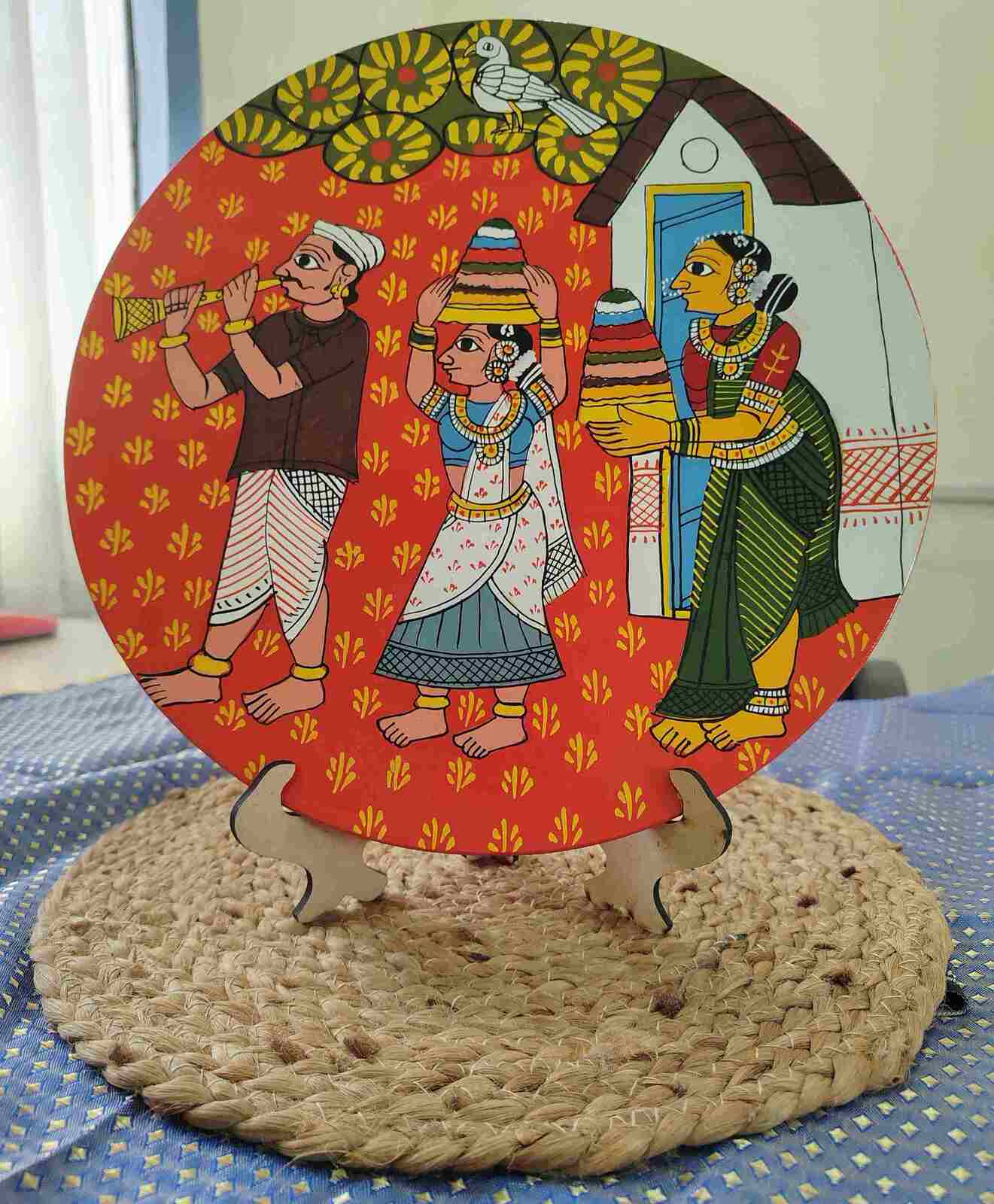
Unlike classical Indian art that depicted kings and divine realms, Cheriyal featured everyday people—toddy tappers, weavers, washermen, farmers, women at work, village celebrations, laughter, and sorrow. This grounded and human quality is what makes Cheriyal painting deeply relatable and emotionally honest.
The Visual Identity of Cheriyal Art
Cheriyal paintings have a unique visual style that instantly sets them apart:
Feature | Description |
Background Color | Deep vermilion red—symbolic, warm, dramatic |
Figures | Strong outlines, rounded faces, minimal shading |
Palette | Natural colors: white, red, yellow, green, black, blue |
Expression | Highly expressive faces—emotion is central |
Perspective | Flat, two-dimensional, storytelling oriented |
Narrative Layout | Sequential scenes like comic panels or film shots |
This directness makes Cheriyal paintings engaging even without explanation. The viewer can sense action, emotion, character, and story through the gesture and posture of every figure.
The Craftsmanship Process – A Sacred Practice
Creating a Cheriyal artwork involves time, patience, and generations of knowledge. Every piece is handcrafted, using locally available natural materials.
1. Preparing the Canvas
The base is made using Khadi cloth. It is coated with a mixture of:
- White river clay
- Rice starch
- Tamarind seed paste
- Natural tree gum
Each layer is sun-dried and polished to achieve a smooth, strong surface that can last over 100 years.
2. Natural Color Preparation
Cheriyal colors are made from organic materials:
- Red: Ground stone pigments
- Black: Lamp soot mixed with gum
- Yellow: Turmeric extracts
- White: Crushed sea shells
- Green & Blue: Mineral stones
These colors do not fade easily and remain vibrant for decades.
3. Painting
The artist begins with light outlines, fills backgrounds, and builds the story one frame at a time. Faces are the soul of Cheriyal art—the expression reveals the emotion and narrative.
4. Border & Finishing
Delicate floral or patterned borders complete the piece, giving it a storytelling frame.
No computers. No prints. No machines.
Just hands, tradition, and love.
Cheriyal Masks, Dolls & Modern Relevance
To keep the art accessible in modern homes, Cheriyal artisans now create:
- Wall masks (decorative and character-based)
- Miniature framed paintings
- Sawdust dolls
- Utility décor pieces
These adaptations preserve the spirit of storytelling, while fitting stylishly into contemporary interiors.
Why Cheriyal Art Matters Today
In a world of mass production and digital prints, Cheriyal represents:
- Authenticity
- Slowness
- Cultural rootedness
- Human touch
Every purchase supports:
- Artisan livelihoods
- Cultural continuity
- Sustainable craft tradition
Cheriyal in Home Décor
Cheriyal art fits beautifully in:
- Living rooms
- Study rooms
- Creative studios
- Cultural display corners
- Restaurants & boutique spaces
Care & Maintenance
- Keep away from direct sunlight
- Clean with soft dry cloth only
- Avoid moisture and chemical cleaners
- Frame under glass for best protection (for scrolls/miniatures)
With proper care, Cheriyal paintings can last more than a century.
Why Buy Cheriyal from CraftCoup
CraftCoup works directly with artisan families, ensuring:
- Fair and respectful pricing
- No middlemen exploitation
- Guaranteed authenticity
- Consistent quality
- Cultural preservation with dignity
When you buy from CraftCoup, you are not just decorating your home—you are supporting a heritage that the world must not lose.